







LIBRARY
The March Of The Revenant
Interview with Varg Vikernes
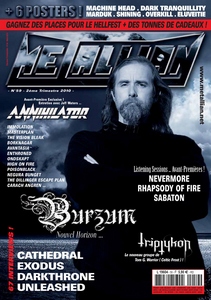
"Metallian" magazine (#59, March 2010)
Laurent Michelland
The seasons follow one another, unchangingly. Days, months, years pass by, slowly or quickly, according to the circular rites of time, from the Spring equinox to the Winter solstice. Yet there is one who, with his prophetic gaze, contemplates these phenomenons from his solar throne: Belus. A supernatural hero who gave his name to the album embodying the resurrection of Burzum after eleven years of enforced musical silence. Expressed like a prophetic tale, this seventh chapter in the musical journey of Varg Vikernes reconnects with the thread of his earliest works, with those unique Black Metal sounds, those atmospheres that haunt you, unsettle you, and intoxicate you with the vast fragrance of elsewhere. Where, in secret, the powers of the gods unite with the strengths of man to give birth to a new being - of yesterday, today, and tomorrow
***
May 24th, 2009 is a symbolic date, since it marks your release from prison: a legal and physical freedom after sixteen long years of incarceration. What emotions and images crossed your mind on that particular day?
Although this was the officially announced date, I was actually released on May 11th, 2009, and I must say that I am still not free. I am under probation for a period of one year. I have to admit I felt nothing special upon leaving prison, because my mind had never been imprisoned.
As January 2010 comes to an end, could you reveal the musical direction of Burzum's long-awaited seventh album? Where would you place this opus within your discography?
The audience can expect a fully metal album, without the integration of "ambient" passages. The eight tracks are performed in a melodic, melancholic and monotone register, in the style of the early pieces featured on "Filosofem" and "Hvis Lyset Tar Oss". As for the production, the sound is of much higher quality, and I think the vocals are as well.
It is on Byelobog Productions, your own label, that "Belus" will be released: should we see this structure as a continuation of Cymophane Productions?
Why does everyone think Byelobog Productions is my label? It is not. Releasing a Burzum album is not something that goes unpunished by the music community, and therefore my label prefers to continue its operations in the shadows...
Among the eight tracks appearing on the successor to "Hliðskjálf", there are two older ones: an unreleased piece dating from 1988 89, as well as a new version of "Dauði Baldrs" from the album of the same name. Why did you decide to include these two compositions in the new repertoire?
You should know that "Dauði Baldrs" was originally conceived as a metal track, which is why it reappears on "Belus". The "Uruk-Hai" song (Sverddans), meanwhile, is musically very different from the others because it was composed in 1988: its sound is closer to "Ea, Lord Of The Depths" than to the recently completed repertoire.
As suggested by its title, the album marking Burzum's return is dedicated to Belus, the ancient European solar deity of light and innocence. What led you to choose the White God as a concept?
It is what I know best. My interest in the modern world is close to zero, so I mainly prefer to study and adopt ancient myths. Some subjects transcend time, like the dialogues of Plato, Aristotle, Socrates, and other Greek philosophers. They were written thousands of years ago, yet their message is still relevant today. Conversely, very little of what we discover today will still be valid in a few months or even tomorrow.
The story told on this album is thematically divided into three parts: the death of Belus, his journey through the underworld, and his return. Can you elaborate on the events and consequences of this prophetic tale?
Death, the mystical visit to the realm of the dead, and the magnificent return from the underworld is a subject that has fascinated mankind for centuries. The White God, Belus, remains white, innocent, and pure, because he does this every year, and each time he crosses the river of forgetfulness. He dies, is rejuvenated, and is reborn again and again, endlessly, like everything else in nature. My main focus is on the sorcerer of pre-mythology and his approach to this problem: his personal death, his journey into the realm of the dead, and his symbolic "rebirth." I place the myth and the sorcerer's journey side by side, showing the origin of the myth. No one has done this before. Belus means something to me - and perhaps to others - though not necessarily with the same meaning.
Do you believe in the theory of the eternal return, illustrated for example by the Ouroboros, which signifies that time is not linear but cyclical, and that things repeat themselves in a cycle leading from destruction to rebirth?
The linear understanding of the universe is Judeo-Christian, whereas its cyclical approach belongs to the pagan world. This means that original beginnings, myth-making creations, as well as permanent endings are, in our understanding of pagan mythology, Judeo-Christian misinterpretations. If we consider the universe from a cyclical point of view, there is no beginning, nor end. The world turns and turns again upon itself, and this is what it has always done. That is the primary symbolism of the circle.
Having a pagan conception of the surrounding world, I perceive things from the cycle's perspective. But whether or not this theory can be applied to the human spirit is another question. It is a beautiful and romantic idea, but we cannot know more about it. Regressive hypnotherapy, déjà vu experiences, and other theories and metaphysical questions prove nothing. That said, my mind is open to the possibility of rebirth.
The lyrics of "Belus" are written in Norwegian, but you announced that translations would be available in French and Russian. Could you explain why you chose these two languages in particular? Do you feel a special attachment to France and Russia?
In fact, I did not choose only French and Russian: a German translation will soon be added, and it is also possible that Italian and Dutch versions will complete the picture. France is to the modern (post-Roman) world what Greece was to the ancient (pre-Roman) world: the cradle of civilization and culture. Germany and everything to the north and east were wild lands. Until the XIXth century, Brittany was populated by pirates who lived by plundering other European countries, mainly Spain, Portugal, France, and the Netherlands. Spain was invaded by the Moors, Italy was plunged into Machiavellian disorder, while the Balkans were either wild or occupied by the Ottomans. I think all more or less civilized Europeans should maintain a positive relationship with France.
As for Russia, I must say that I particularly enjoy the music of that country, as well as its language. I have always considered myself a Russophile.
How do you perceive the fact that a man with convictions, ready to die for his ideals, is generally regarded as an outlaw in today's society, whereas in ancient times this same person would have been considered loyal, courageous, and strong?
This phenomenon is a natural consequence of Judeo-Christianity and other forms of internationalism. When one abandons one's pagan and European ideals, one also abandons life.
As a citizen of the XXIst century, you have witnessed the spiritual regression of the modern world, governed among other things by the weapons of materialism, capitalism, and egalitarianism, which has worsened over the past few decades In your opinion, what would be the solutions to reverse a situation that worsens every day?
It is like a tidal wave. The only sensible thing a man can do is to remove himself from its waves and wait until this deluge submerges our planet, destroying the world order. Only then can the wise return, descending from the mountains, to build a new world. If we lose ninety-nine percent of our species in this process, it can only be a good thing. The remaining one percent will be all the better for it.
Let us now discuss your activity as a writer. An activity that began with the writing of "Vargsmål" in 1994, and since then, you have written seven other books. Over the years, have you noticed changes in your writing style? If you had to compare literary expression with musical expression, how would you describe it?
Yes, there has been a change: nowadays, I no longer concern myself with warning people about this or that threat. The last book I wrote, "Trolldom Og Religion I Oldtidens Skandinavia" (Sorcery and Religion in Ancient Scandinavia), deals only with sorcery and religion, and no other subject is addressed. It is a work that describes the religion of our ancestors very precisely, if I may say so. I used Scandinavian mythology as an example because it is the one I know best, but it is valid for all Europeans, not just the Scandinavian peoples. I would add that the content is one hundred percent apolitical, and I intend for it to remain so in the future.
To compare literature with music, I would give an analysis that is more or less accurate: writing could be described as an intellectual activity, whereas musical composition belongs more to the realm of emotions.
Do you know when the English version of "Sorcery and Religion in Ancient Scandinavia" will be available to the public?
I am not yet certain when the translation will be ready. At present, I must devote almost all my available time to promoting "Belus". But once that task is finished, I can pick up where I left off in the translation (about halfway through) and complete the work.
In other languages: Français, Italiano
Although this was the officially announced date, I was actually released on May 11th, 2009, and I must say that I am still not free. I am under probation for a period of one year. I have to admit I felt nothing special upon leaving prison, because my mind had never been imprisoned.
As January 2010 comes to an end, could you reveal the musical direction of Burzum's long-awaited seventh album? Where would you place this opus within your discography?
The audience can expect a fully metal album, without the integration of "ambient" passages. The eight tracks are performed in a melodic, melancholic and monotone register, in the style of the early pieces featured on "Filosofem" and "Hvis Lyset Tar Oss". As for the production, the sound is of much higher quality, and I think the vocals are as well.
It is on Byelobog Productions, your own label, that "Belus" will be released: should we see this structure as a continuation of Cymophane Productions?
Why does everyone think Byelobog Productions is my label? It is not. Releasing a Burzum album is not something that goes unpunished by the music community, and therefore my label prefers to continue its operations in the shadows...
Among the eight tracks appearing on the successor to "Hliðskjálf", there are two older ones: an unreleased piece dating from 1988 89, as well as a new version of "Dauði Baldrs" from the album of the same name. Why did you decide to include these two compositions in the new repertoire?
You should know that "Dauði Baldrs" was originally conceived as a metal track, which is why it reappears on "Belus". The "Uruk-Hai" song (Sverddans), meanwhile, is musically very different from the others because it was composed in 1988: its sound is closer to "Ea, Lord Of The Depths" than to the recently completed repertoire.
As suggested by its title, the album marking Burzum's return is dedicated to Belus, the ancient European solar deity of light and innocence. What led you to choose the White God as a concept?
It is what I know best. My interest in the modern world is close to zero, so I mainly prefer to study and adopt ancient myths. Some subjects transcend time, like the dialogues of Plato, Aristotle, Socrates, and other Greek philosophers. They were written thousands of years ago, yet their message is still relevant today. Conversely, very little of what we discover today will still be valid in a few months or even tomorrow.
The story told on this album is thematically divided into three parts: the death of Belus, his journey through the underworld, and his return. Can you elaborate on the events and consequences of this prophetic tale?
Death, the mystical visit to the realm of the dead, and the magnificent return from the underworld is a subject that has fascinated mankind for centuries. The White God, Belus, remains white, innocent, and pure, because he does this every year, and each time he crosses the river of forgetfulness. He dies, is rejuvenated, and is reborn again and again, endlessly, like everything else in nature. My main focus is on the sorcerer of pre-mythology and his approach to this problem: his personal death, his journey into the realm of the dead, and his symbolic "rebirth." I place the myth and the sorcerer's journey side by side, showing the origin of the myth. No one has done this before. Belus means something to me - and perhaps to others - though not necessarily with the same meaning.
Do you believe in the theory of the eternal return, illustrated for example by the Ouroboros, which signifies that time is not linear but cyclical, and that things repeat themselves in a cycle leading from destruction to rebirth?
The linear understanding of the universe is Judeo-Christian, whereas its cyclical approach belongs to the pagan world. This means that original beginnings, myth-making creations, as well as permanent endings are, in our understanding of pagan mythology, Judeo-Christian misinterpretations. If we consider the universe from a cyclical point of view, there is no beginning, nor end. The world turns and turns again upon itself, and this is what it has always done. That is the primary symbolism of the circle.
Having a pagan conception of the surrounding world, I perceive things from the cycle's perspective. But whether or not this theory can be applied to the human spirit is another question. It is a beautiful and romantic idea, but we cannot know more about it. Regressive hypnotherapy, déjà vu experiences, and other theories and metaphysical questions prove nothing. That said, my mind is open to the possibility of rebirth.
The lyrics of "Belus" are written in Norwegian, but you announced that translations would be available in French and Russian. Could you explain why you chose these two languages in particular? Do you feel a special attachment to France and Russia?
In fact, I did not choose only French and Russian: a German translation will soon be added, and it is also possible that Italian and Dutch versions will complete the picture. France is to the modern (post-Roman) world what Greece was to the ancient (pre-Roman) world: the cradle of civilization and culture. Germany and everything to the north and east were wild lands. Until the XIXth century, Brittany was populated by pirates who lived by plundering other European countries, mainly Spain, Portugal, France, and the Netherlands. Spain was invaded by the Moors, Italy was plunged into Machiavellian disorder, while the Balkans were either wild or occupied by the Ottomans. I think all more or less civilized Europeans should maintain a positive relationship with France.
As for Russia, I must say that I particularly enjoy the music of that country, as well as its language. I have always considered myself a Russophile.
How do you perceive the fact that a man with convictions, ready to die for his ideals, is generally regarded as an outlaw in today's society, whereas in ancient times this same person would have been considered loyal, courageous, and strong?
This phenomenon is a natural consequence of Judeo-Christianity and other forms of internationalism. When one abandons one's pagan and European ideals, one also abandons life.
As a citizen of the XXIst century, you have witnessed the spiritual regression of the modern world, governed among other things by the weapons of materialism, capitalism, and egalitarianism, which has worsened over the past few decades In your opinion, what would be the solutions to reverse a situation that worsens every day?
It is like a tidal wave. The only sensible thing a man can do is to remove himself from its waves and wait until this deluge submerges our planet, destroying the world order. Only then can the wise return, descending from the mountains, to build a new world. If we lose ninety-nine percent of our species in this process, it can only be a good thing. The remaining one percent will be all the better for it.
Let us now discuss your activity as a writer. An activity that began with the writing of "Vargsmål" in 1994, and since then, you have written seven other books. Over the years, have you noticed changes in your writing style? If you had to compare literary expression with musical expression, how would you describe it?
Yes, there has been a change: nowadays, I no longer concern myself with warning people about this or that threat. The last book I wrote, "Trolldom Og Religion I Oldtidens Skandinavia" (Sorcery and Religion in Ancient Scandinavia), deals only with sorcery and religion, and no other subject is addressed. It is a work that describes the religion of our ancestors very precisely, if I may say so. I used Scandinavian mythology as an example because it is the one I know best, but it is valid for all Europeans, not just the Scandinavian peoples. I would add that the content is one hundred percent apolitical, and I intend for it to remain so in the future.
To compare literature with music, I would give an analysis that is more or less accurate: writing could be described as an intellectual activity, whereas musical composition belongs more to the realm of emotions.
Do you know when the English version of "Sorcery and Religion in Ancient Scandinavia" will be available to the public?
I am not yet certain when the translation will be ready. At present, I must devote almost all my available time to promoting "Belus". But once that task is finished, I can pick up where I left off in the translation (about halfway through) and complete the work.
Author: Laurent Michelland (© 2010 "Metallian" magazine, France)
Translated from French by Joris
In other languages: Français, Italiano